01The question
Can waste become something that keeps people healthy?
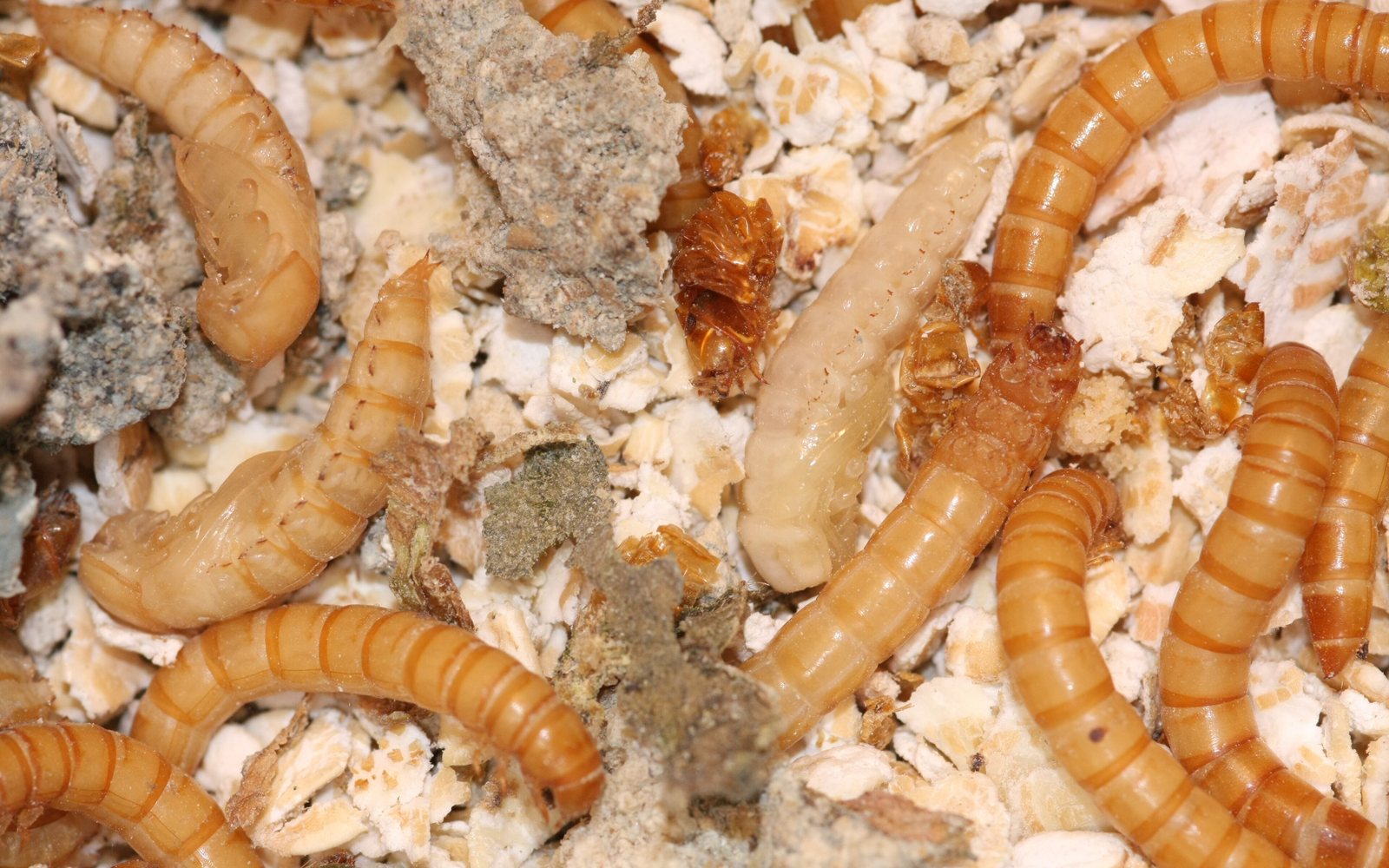
Styrofoam and coffee grounds pile up in every household. Wonjun wanted a solution that did two things at once: reduce waste in an environmentally friendly way, and create added value that directly benefits people's health. Mealworms offered a starting point. Peer-reviewed research had shown they can eat and digest polystyrene and excrete it as safe material, and their exoskeletons, like those of shrimp and crabs, contain chitin, the raw material for antibacterial chitosan.
02The gap
Why does chitosan work so differently from study to study?
Reviewing 12 SCI/SCIE papers through Korea's RISS academic database, Wonjun noticed two gaps. First, there was no research on mealworms eating household waste other than Styrofoam. Second, reported antibacterial effects of chitosan varied widely across studies. He formed two hypotheses: mealworms could likely survive on other household waste, and the antibacterial power of chitosan would depend on which species it came from and what that animal ate.
- Q1: Does chitosan's antibacterial effect differ between species?
- Q2: Does it change depending on what the insect is fed?
03Step 1
Gathering the enemy, including superbugs
He collected four bacterial targets using selective media: Staphylococcus aureus on mannitol salt agar, Bacillus cereus on PEMBA agar, and two antibiotic-resistant strains of S. aureus grown on media containing vancomycin or chloramphenicol. Including vancomycin-resistant (VRSA) and chloramphenicol-resistant (CRSA) strains meant the test would show whether insect chitosan could matter where conventional antibiotics struggle.
04Step 2
From insect shell to chitosan
Extraction followed a four-stage chemical process. Hydrochloric acid (1 M) dissolved carbonates and calcium. Five hours of heating in 1 M sodium hydroxide broke down proteins. Hydrogen peroxide removed the remaining pigments, leaving pure chitin. Finally, heating in concentrated 19 M sodium hydroxide stripped off acetyl groups, turning chitin into chitosan. The same procedure was applied to supermealworms, mealworms, shrimp and crab so they could be compared fairly.
05Step 3
Supermealworms beat shrimp and crab
Each bacterium was grown for 12 hours at 36 °C in broth containing chitosan from 0% to 2.0%, refined to 0.1% steps, and the lowest concentration that kept the broth clear was recorded. Supermealworm chitosan needed the least every time: 0.2% for B. cereus and 1.0% for S. aureus. The ranking was consistent: supermealworm, then mealworm, then shrimp, then crab. Resistant strains needed more chitosan, in the order CRSA, VRSA, S. aureus, B. cereus.
06Step 4
Putting supermealworms on a garbage diet
Next, groups of 100 supermealworms were raised for two weeks on millet, Styrofoam or coffee grounds. All survived. Growth was highest on millet (16.9%), followed by Styrofoam (14.2%) and coffee grounds (11.3%). The coffee-fed larvae also changed colour, their skin turning a much darker maroon, a visible hint that diet was altering their bodies.
07The surprise
Coffee grounds made stronger chitosan
Chitosan from Styrofoam-fed supermealworms performed exactly like the millet control. But chitosan from coffee-fed larvae was about 20% more potent: S. aureus was stopped at 0.8% instead of 1.0%, and both resistant strains at 1.0% instead of 1.2–1.3%. The trade-off was slower growth, which matters for productivity and cost.
08The fix
A mixed diet gets the best of both
Feeding Styrofoam and coffee grounds together solved the trade-off and the larvae's selective eating. Growth rebounded to 15.4%, little different from millet, while chitosan stayed nearly as strong as with coffee alone: 0.9% for S. aureus, 1.0% for VRSA and 1.1% for CRSA. Wonjun envisions a 'bio-recycling factory' where supermealworms consume household waste and their shells become antibacterial material.